
How to Build an Effective Sales Pipeline: A Practical Guide for Growing Businesses
Quick answer
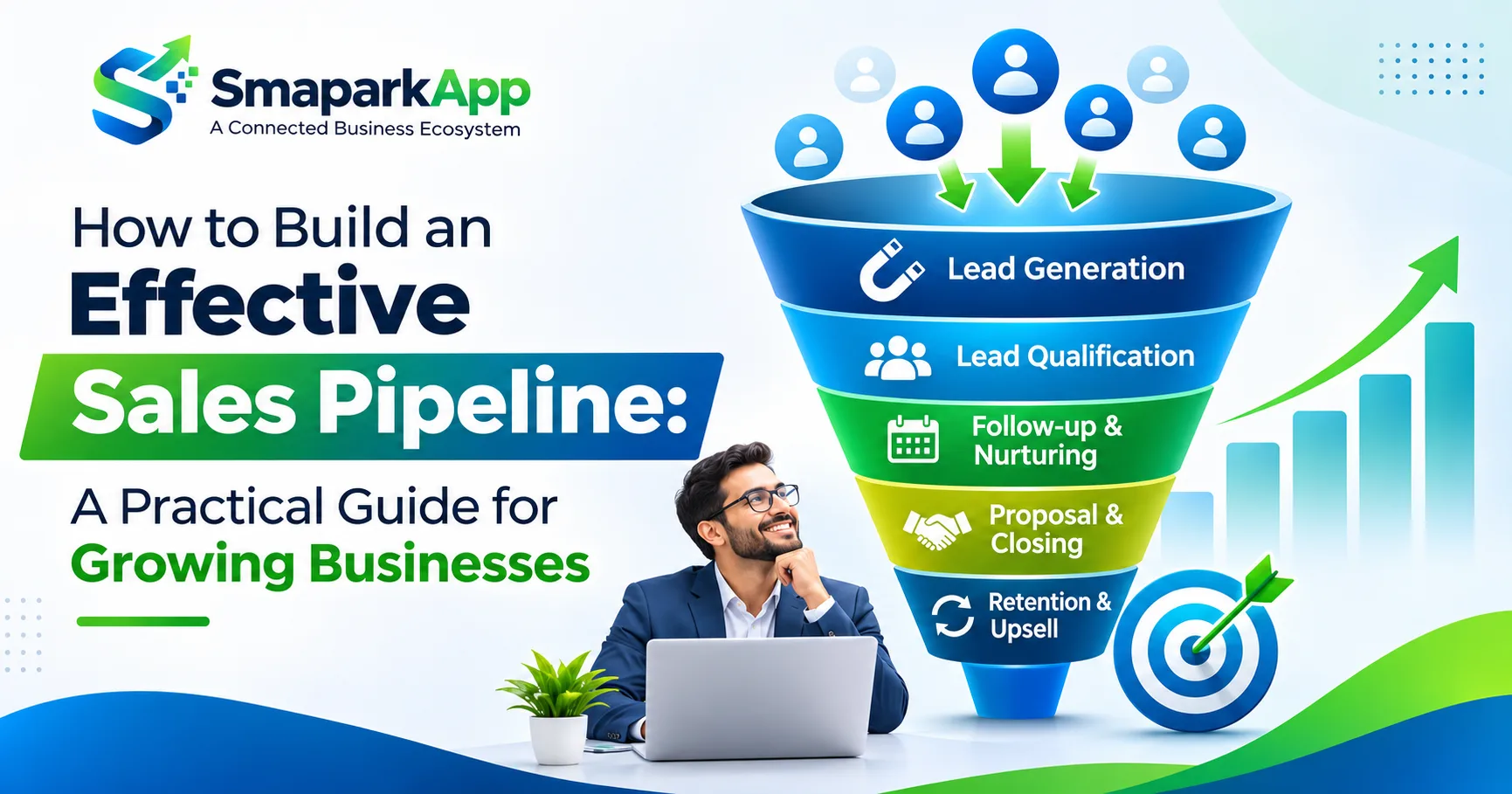
An effective sales pipeline is a clear path every enquiry follows from first contact to paying customer. Capture every lead in one place, define simple stages (New, Contacted, Qualified, Proposal, Won), assign an owner and next action, follow up promptly on WhatsApp and email, and review weekly to fix where leads stall. A CRM keeps it all connected.
An effective sales pipeline is a clear, step-by-step path that every enquiry follows, from first contact to a paying customer. To build one, you need to do five things: 1. Bring every lead into one place. 2. Define simple stages such as New, Contacted, Qualified, Proposal and Won. 3. Give every lead an owner and a next action. 4. Follow up on time, using WhatsApp and email. 5. Review the numbers e
What is a sales pipeline?
A sales pipeline is a visual, stage-by-stage view of where each potential customer stands in your buying process. It answers one question at any moment: who is close to buying, who needs a nudge and who has gone quiet?
A small interiors company might see it like this. Rohan enquired about an office interior in Gurugram yesterday. Meher is waiting for a wedding decor proposal that is due today. Ananya just messaged on WhatsApp and is waiting for a reply right now. Three people, three different stages, three different next actions. A good pipeline shows all of that at a glance.
If you have ever scrolled through old WhatsApp chats trying to remember who you promised a quote to, you already know why this matters.
Sales pipeline vs sales funnel: what is the difference?
People use the two terms interchangeably, but they look at the same thing from different angles.
|
|
Sales pipeline |
Sales funnel |
|
Focus |
The actions your team takes at each stage |
The shrinking number of prospects at each stage |
|
Question it answers |
What should we do next with this lead? |
How many leads are we losing, and where? |
|
Used for |
Daily work and follow-ups |
Conversion analysis and forecasting |
In practice, you need both. The pipeline tells your team what to do today. The funnel tells you whether the process is working.
Why does your business need an effective sales pipeline?
Without a pipeline, sales depends on memory and mood. With one, it depends on process.
Here is what changes when you get it right:
• No enquiry is forgotten. Every lead has a stage and a due date.
• Replies get faster. Your team knows who to respond to first.
• Forecasting becomes realistic. You can see how many proposals are open and how many are likely to close.
• New team members learn quickly. The process is written into the system, not stored in one person's head.
• You can see what is broken. If leads pile up at the proposal stage, you know exactly where to look.
How to build an effective sales pipeline: 7 steps
Step 1: Map how your customers actually buy
Start with reality, not a template. Sit down with the people who talk to customers and write down what really happens between the first message and the final payment.
Ask simple questions:
• How do customers first reach us? Website form, ad, WhatsApp, phone call, referral?
• What do we usually do in the first hour, first day and first week?
• Where do deals normally slow down?
• What has to happen before someone says yes?
A coaching institute, a clinic and a manufacturing business all sell differently. A walk-in clinic may close in a day. A B2B supplier may take three months and five approvals. Your pipeline should mirror your process, not someone else's.
Step 2: Capture every lead in one place
Your pipeline is only as good as the leads that enter it. If enquiries arrive through Meta lead ads, Google Ads, your website, email and WhatsApp, and each one lives in a different app, some will always slip through.
Bring them into a single workspace. With SamparkApp, enquiries from your website, ads, forms and connected tools land in one CRM, so your team starts every morning with the full picture. You can also connect the lead sources you already use, including Meta and Facebook lead ads, Google Ads, WhatsApp, email and landing pages, subject to supported integrations and account permissions.
Step 3: Define simple, clear pipeline stages
This is where most businesses go wrong. They either have no stages or twelve of them.
For most small and mid-sized businesses, five stages are enough:
|
Stage |
What it means |
Typical next action |
|
New |
A fresh enquiry has arrived |
Reply quickly and acknowledge |
|
Contacted |
You have spoken to the lead |
Understand their need and budget |
|
Qualified |
They are a real fit and are interested |
Prepare a proposal or quote |
|
Proposal |
A proposal has been shared |
Follow up before it goes cold |
|
Won |
They have paid or confirmed |
Onboard and deliver |
You can add Lost or On hold for deals that do not move forward, and record the reason. That reason is valuable data later.
The rule is simple: every stage should have a clear entry condition. If two people on your team would put the same lead in different stages, the stage is not defined well enough.
SamparkApp lets you define your own pipeline stages, fields and follow-up rules, so the CRM fits your business instead of forcing you into a fixed template.
Step 4: Qualify leads so your team focuses on the right people
Not every enquiry deserves the same effort. A lead who has shared a budget and a deadline is different from someone who is just browsing.
Qualify early, using a few honest questions:
• Need: What problem are they trying to solve?
• Budget: Do they have a realistic range in mind?
• Timeline: When do they want to start?
• Decision-maker: Who finally approves the purchase?
Then prioritise. Lead scoring helps here, because it pushes high-intent prospects to the top and lets your team schedule gentler nurturing for colder leads. In SamparkApp, lead scoring and nurturing are part of every workspace, so your priority queue is always ordered by the next action that matters.
Step 5: Assign an owner and a next action to every lead
A lead with no owner is a lead nobody is chasing. A lead with no next action is a lead that will quietly die.
Make this a non-negotiable rule: every open lead has one owner and one dated next step. For example, "Send proposal by 5 pm today" or "Call on Thursday after site visit."
When the next action lives on the lead's record, your team does not need daily reminders from the manager. The system does the reminding.
Step 6: Follow up fast, on WhatsApp and email
This is the step that decides most deals.
Customers today expect quick replies, especially on WhatsApp. If someone enquires at 11 am and hears back the next afternoon, they have probably already spoken to two other providers.
A good follow-up system has three parts:
1. Instant acknowledgement. The moment an enquiry arrives, the customer gets a reply. It can be a short, friendly WhatsApp message with a question that moves the conversation forward.
2. Scheduled follow-ups. If the customer goes silent after a proposal, a follow-up goes out after a set number of days. Then another, with a different angle.
3. Personal touch where it counts. Automation handles the routine. Your team handles the conversation.
This is exactly what WhatsApp automation in SamparkApp is built for. It supports automated follow-ups, approved marketing messages and chatbot replies, all filed against the right customer record. So when your team opens a lead, they can see what was sent, when, and what the customer said back.
Email still matters too, especially for proposals, updates, reminders and longer explanations. With email automation, follow-ups and updates can be triggered by lead status or milestones. When a lead moves to Proposal, for instance, the right email can go out without anyone having to remember.
A simple follow-up rhythm many teams use:
• Within minutes: Acknowledge the enquiry on WhatsApp.
• Same day: Share relevant details or a brochure.
• Day 2 or 3: Check whether they have questions.
• Day 5 to 7: Send a gentle reminder about the proposal.
• Day 14: Send a final, polite check-in, then move the lead to nurture or on hold.
Adjust the timing to your sales cycle. A salon booking needs a different rhythm than a factory machinery order.
Step 7: Track proposals, bookings and payments to the finish line
Many pipelines stop at "proposal sent." That is where the real risk starts, because proposals go quiet quickly.
Track every proposal: who it went to, whether it has been viewed, and when you last followed up. SamparkApp lets you create and share proposals and see which ones are still pending, so you can follow up before the opportunity cools.
Once the customer says yes, keep the process tight. Confirm the booking, send reminders, and nudge payments when needed. When a payment arrives, the confirmation can go out automatically, and the lead moves to Won with the advance amount recorded on the timeline.
Which sales pipeline metrics should you track?
You do not need fifty dashboards. Start with these six:
1. Lead volume by source: Which channels bring enquiries?
2. Lead quality by source: Which channels bring people who actually buy?
3. Speed to first response: How long does a new lead wait for a reply?
4. Stage-to-stage conversion: What share of leads move from one stage to the next?
5. Average time in each stage: Where do deals slow down?
6. Overdue follow-ups: How many leads have a missed next action?
The last one is underrated. A growing list of overdue follow-ups is the earliest warning sign that revenue is leaking.
SamparkApp's growth analytics and AI business analysis are designed around these questions. You can compare lead sources, find follow-up gaps, spot pipeline bottlenecks and review improvement ideas with your team.
Common sales pipeline mistakes (and how to avoid them)
Too many stages. If your team needs a manual to understand the pipeline, they will stop using it. Keep it simple.
No clear stage definitions. Write down what "Qualified" means in your business, in one sentence.
Updating the pipeline once a week. Stale data is worse than no data. Update as you work, ideally automatically.
Treating all leads the same. A hot lead and a cold lead need different speed and different effort.
Forgetting existing customers. Repeat orders, referrals and renewals are part of the pipeline too.
Ignoring lost deals. Record why deals were lost. After a month or two, patterns appear, and they are usually fixable.
Using too many disconnected tools. When leads live in one app, messages in another and payments in a third, things fall through the gaps. One connected system removes most of those gaps.
Sales pipeline examples for different businesses
The same five-stage structure adapts to many industries. Only the details change.
• Services and agencies: New enquiry, discovery call, proposal, negotiation, project start.
• Education and coaching: Enquiry, demo class or counselling call, fee discussion, enrolment, payment.
• Healthcare and wellness: Enquiry, appointment booked, consultation done, treatment plan, follow-up visit.
• Real estate: Enquiry, site visit scheduled, site visit done, negotiation, booking amount received.
• eCommerce and retail: Query, product recommendation, quote or cart follow-up, order, repeat purchase.
• B2B and manufacturing: Enquiry, requirement gathering, quotation, approvals, purchase order.
Whichever model fits you, the principle holds: every lead has a stage, an owner and a next action.
How can SamparkApp help you build and run your sales pipeline?
SamparkApp is built for exactly this job. It keeps leads, WhatsApp, email, proposals and payments in one CRM, so no customer waits for a reply.
Here is how it maps to the steps above:
|
Pipeline need |
What SamparkApp offers |
|
Capture leads |
Enquiries from ads, forms, website and connected tools in one CRM |
|
Define stages |
Custom pipeline stages, fields, teams and follow-up rules |
|
Prioritise |
Lead scoring and nurturing, with owners assigned to each lead |
|
Follow up on WhatsApp |
Automated follow-ups, approved marketing messages and chatbot replies, logged on the lead's timeline |
|
Follow up by email |
Email automation triggered by lead status or milestones |
|
Track proposals |
Create, share and monitor proposals |
|
Close and collect |
Bookings, reminders and payment nudges, with automatic confirmation when payment arrives |
|
Improve |
Growth analytics and AI business analysis to find bottlenecks and missed steps |
If you would like to see how this fits your own process, you can request a demo. Tell us about your business and the process you want to improve, and we will reply with a demo suited to it.
Frequently asked questions
What are the stages of a sales pipeline?
Most pipelines include New, Contacted, Qualified, Proposal and Won. Many businesses also add Lost or On hold. The best stages are the ones that match how your customers actually buy, so adapt the names and number to your process.
How many stages should a sales pipeline have?
Five to seven is usually enough. More than that makes the pipeline hard to maintain, and your team will stop updating it. If a stage does not trigger a different action, merge it with another.
What is the difference between a sales pipeline and a CRM?
A sales pipeline is the process your leads move through. A CRM is the software that holds that process, along with customer details, conversations, follow-ups and reports. A CRM turns your pipeline from an idea into a working system.
How do I know if my sales pipeline is healthy?
Check four signs. New leads get a fast first reply. Every open lead has an owner and a next action. Few follow-ups are overdue. And leads move steadily from stage to stage rather than piling up in one place.
How often should I review my sales pipeline?
Your team should work from it daily and review it as a group weekly. Once a month, look at the bigger picture: lead sources, conversion between stages and reasons for lost deals.
Can WhatsApp be part of a sales pipeline?
Yes, and for many Indian businesses it is the most important channel. The key is to connect WhatsApp to your CRM so every message is linked to the right lead, rather than lost in personal chats. Automation can handle acknowledgements and reminders, while your team handles real conversations.
How do I stop leads from going cold?
Reply fast, set a follow-up for every lead, and use a simple rhythm of WhatsApp and email reminders. Review leads that have gone quiet each week, and decide whether to re-engage, nurture or close them.
Is a sales pipeline only for big sales teams?
No. A solo founder or a three-person team benefits just as much, sometimes more. When there are few people, a single missed follow-up costs a larger share of revenue.